Service Area 1
Network status
All corridors operating except as noted below. Two active advisories. Last corridor survey: W31.
Corridors
90-day window| Corridor | Span | Rated capacity | Wind ceiling | Status | Uptime |
|---|---|---|---|---|---|
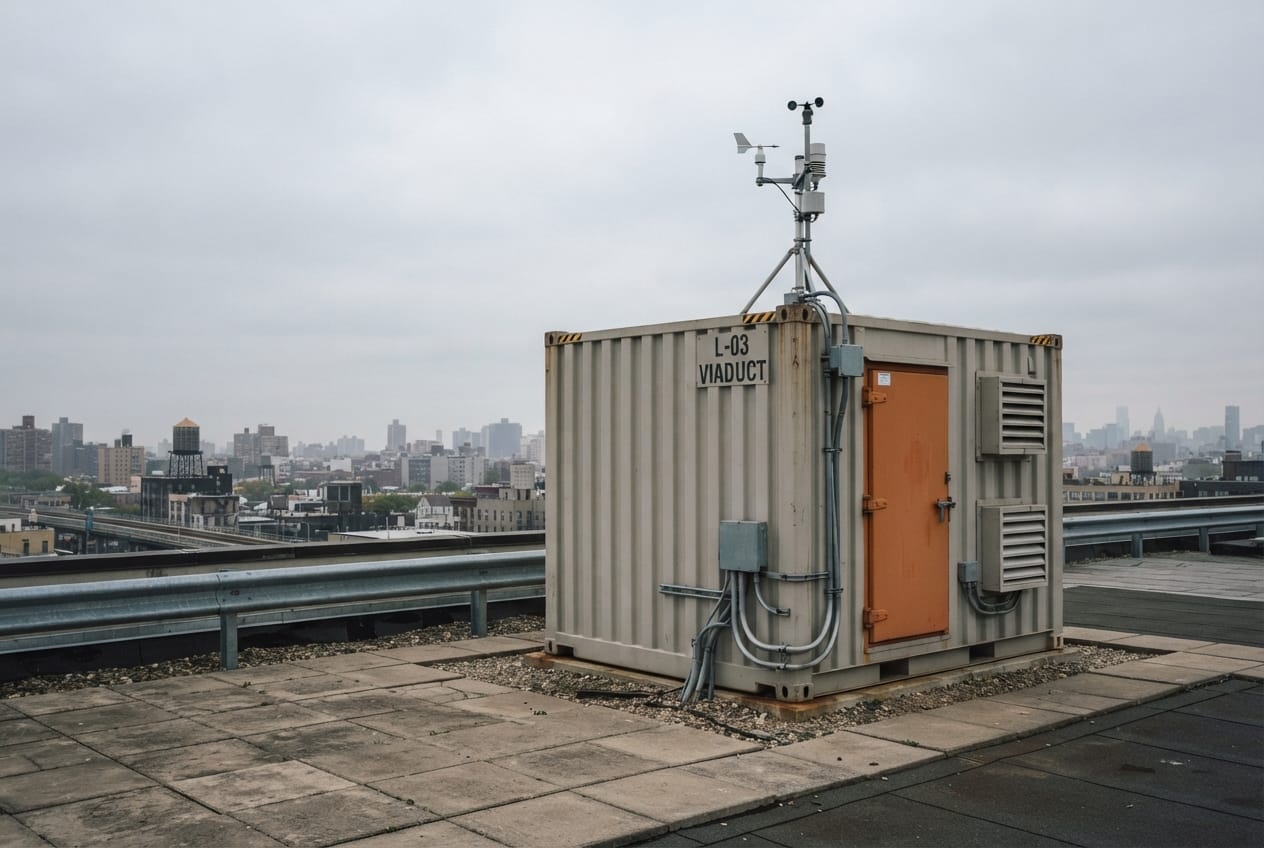
| COR-N1 | L-01 GRANARY — L-03 VIADUCT | 26 assets/hr | 42 km/h | NOMINAL | 99.6% |
| COR-N2 | L-03 VIADUCT — L-07 TANNERY | 18 assets/hr | 40 km/h | NOMINAL | 99.4% |
| COR-E1 | L-07 TANNERY — L-05 COLD STORAGE | 22 assets/hr | 45 km/h | NOMINAL | 99.1% |
| COR-W2 | L-04 GASWORKS — L-08 SIGNAL HILL | 20 assets/hr | 38 km/h | ADVISORY | 97.8% |
| COR-S2 | L-08 SIGNAL HILL — L-06 CANNERY | 14 assets/hr | 38 km/h | REROUTED | 98.7% |
Uptime is weather-adjusted per SLA v4.2. Intervals under an active advisory are not counted as scheduled availability.
Active advisories
Crosswind 38 km/h gusting 55 at midspan, exceeding the corridor's published 38 km/h ceiling. Capacity reduced to 40%. Priority-class dispatches continue under senior-asset assignment. Review 16:00 local.
Following three contact events in four weeks on the L-08 approach, COR-S2 is rerouted via the southern reservoir alignment (+6 min published transit). All contact events were resolved per SOP-9 with no payload loss. A falconry abatement contractor is engaged through W40. This advisory is reviewed at the weekly safety board and will remain standing until two consecutive contact-free weeks are observed.
Scheduled maintenance
| Window | Site | Work | Impact |
|---|---|---|---|
| SUN 03:00–05:00 | L-04 GASWORKS | Perch array washdown; intake scanner firmware | No dispatches; queued payloads reroute via COR-N2 |
| W38–W44 | NETWORK | Scheduled molt | Capacity −60% network-wide; SLA suspended per §7.3 |
Navigation stack
Assets navigate by magnetoreception (trigeminally mediated; Mora et al., Nature 432), solar azimuth, and learned landmark chains built during corridor certification. There is no positioning hardware aboard: nothing we could attach within the payload ceiling would improve on the asset's own solution.
The transport layer itself has operated commercially since at least 1850, when the Reuter agency bridged the Aachen–Brussels telegraph gap with forty-five assets, beating the train by six hours. Aviary's contribution is the corridor model, the loft network, and the telemetry — the availability engineering the layer always deserved.
References: Mora et al., Nature 432 (2004)· Shawyer et al., Bird Study 55:1 (2008)· Britannica: Paul Julius, Baron von Reuter· Bergen LUG, RFC 1149 implementation (2001)